Description
Boutique German pedal makers KMA Audio Machines combine German engineering and innovation to create truly awe inspiring effects. Each pedal is hand made in Berlin using only the finest components, delivering exceptional tone for a every player. With modern, innovative circuits, KMA is continuously looking forward, whilst drawing inspiration from legendary pedals from bygone eras.
Vintage Inspired
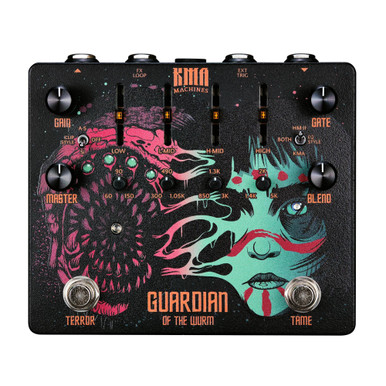
The Guardian of the Wurm is the next evolution of KMA's top selling Wurm distortion pedal. Based on the circuit of the cult classic Boss HM-2 pedal, the Guardian of the Wurm is a "filthy box of doom" that effortless delivers that Swedish death-metal chainsaw sound! The addition of a built in Blackmer® VCA-based Noise Gate ensures that this face melting distortion stays clear and tight, with background noise and hiss kept to a minimum.
Complete Tone Shaping
The Guardian of the Wurm features a highly configurable 4-band Active EQ, with variable centre-frequencies allowing for complete tone shaping. Whether you need that classic heavily mid-scooped distortion, or a gritty, in your face "chainsaw" like sound, the Guardian of the Wurm has you covered. The Clean Blend feature helps preserve your natural core tone by allowing you to blend in your unprocessed signal. This is particularly useful when using the "Wurm" with an already overdriven amp as it retains your natural pick attack and keeps it sounding tight.
Variable Clipping Styles
The Guardian of the Wurm features three unique clipping styles which determine the amount of drive compression. Silicon (Si) mode delivers the original Boss HM-2 like compression, for rich harmonics and smooth leads. Asymmetric (A-S) mode increases the headroom, giving you more grit and bite by retaining the complex harmonics. Finally, OFF mode lifts the sound of the Diodes for a less compressed distortion with more clarity, which is perfect for baritone or bass guitars.
Modern Features
The Guardian of the Wurm is all about flexibility. The External Trigger Input allows you to control the built in Noise Gate from an external source which is perfect for those who like to experiment with noise gates in other creative ways. The built in FX-Loop is located between the distortion and noise gate sections, allowing you to plug in your favourite effects between them.
Specifications
- Powered by 9V PSU (Not Included)
- (9V DC, Centre -, 2.1 mm, >150 mA max. current draw